Start from the source text.
The book supplies the language, claims, imagery, and boundaries, so every course remains connected to the White Noise thesis instead of becoming generic STEM content.

Explore a 1,000-course roadmap inspired by White Noise Totality, across 10 categories and 100 subcategories. Open the published courses marked ready; the remaining entries are in development. Review Member access and the non-accredited certificate format before enrolling.
Image provenance: GPT-generated Academy learning-operating concept created on 2026-06-28 for White Noise Academy positioning. Prompt intent: depict course paths, rubrics, certificate boundary receipts, practicum artifacts, and routes into Labs, Member Portal, and Custom R&D. Asset: assets/academy/wn-academy-learning-operating-surface-20260628.jpg. Review the provenance record. Usage boundary: editorial orientation only, not proof of a live LMS dashboard, accredited credentialing system, staffed lab, or completed research operation.
Browse by topic and level, or begin with an available Foundations course. Study the book’s ideas alongside their assumptions, limitations, and open questions.
The book supplies the language, claims, imagery, and boundaries, so every course remains connected to the White Noise thesis instead of becoming generic STEM content.
Lessons, diagrams, checkpoint quizzes, and finals make the learner explain mechanisms, constraints, and open questions before a certificate is issued.
Your course selections and portal records are stored in this browser. Keep your own copies of important work; these records do not sync across devices or domains.
Strong learners can move toward Labs, Custom R&D, Syndicates, or Club participation with a shared vocabulary and a clearer evidence boundary.
The course roadmap follows a common format inspired by White Noise Totality. Open a published course to review its lessons and assessments; planned entries are labeled in development.
The planned format uses extended lessons to examine a topic’s vocabulary, assumptions, and implications. Available course pages let you inspect the material before deciding what to study.
The course format combines diagrams, examples, three checkpoint quizzes, and a final test. Use the questions to identify ideas that need another look.
Completion certificates describe study within White Noise Academy. They are non-accredited and do not establish professional qualifications or validate the book’s research claims.
The Academy is built so a reader can move from wonder to fluency. The book's parts become pathways, the pathways become courses, and each course ends with enough testing that the idea has to survive contact with your own understanding.

The 1,000-course roadmap spans 10 categories and 100 subcategories, tracing the themes of White Noise Totality from computing concepts to cosmic engineering.
How reality's own entanglement fabric becomes the machine — the foundation the rest of the stack runs on.
Self-building systems that assemble structures — and themselves — at every scale.
Settlements that grow themselves, and a path from one world to a galaxy.
Compiling matter on demand — the Replicator and the physics that make it possible.
Every thing that can exist, indexed and retrievable — knowledge as infrastructure.
What abundance means for the body, the mind and lived experience.
The always-on fabric that links the products into one operating system.
Steering civilization-scale capability — safely, and at speed.
The deep end: minds beyond ours and the rules of the universe itself.
Engineering at the scale of stars — where the stack ultimately points.
Follow the book’s themes, search for a specific question, or focus on one available course. The catalog distinguishes published pages from subjects still in development.
Start at category 01 — Computing & the entanglement substrate — and climb the stack in order, the way White Noise Totality builds it, all the way up to cosmic engineering. Best if you want the whole worldview to click.
Have a question already — replication, superintelligence, space settlement? Search the catalog, filter by category and level, and go straight to the courses that answer it. Best if you're here for something specific.
Choose a published course and work through its lessons and questions. Keep notes on what you understand, what remains uncertain, and what you want to investigate next.
Every category carries the same four levels, so you can meet any topic where you are — start cold or pick up at the edge of the research. The catalog's level filter lets you read the whole stack at the depth that fits you.
No prerequisites. Plain-language entry into a topic that builds the vocabulary and intuition first, before any heavy mechanism — the right place to begin if a subject is brand new to you.
The main mechanisms and arguments of a topic, and the level most courses settle at — enough to actually reason about that part of the stack rather than just recognize the words.
The harder derivations, edge cases and open problems, for when you want to build on a topic instead of only understanding it — where the worked examples get demanding.
Frontier-level treatment that meets the field where the research actually is — the same ground a Custom R&D crew would start from when a question pushes past what is settled.
Levels label depth, not gatekeeping — any course is open with a Member plan. Filter the catalog by level below.
Learning the stack should leave a mark you can point to. A Member plan earns a certificate as you complete each subcategory — credentials that live with your account and accumulate across the whole curriculum.
Work through a subcategory's courses and the Academy issues a certificate for it. With 100 subcategories spanning the ten categories, there are up to 100 credentials to collect as you read across the stack.
Earned certificates attach to your Member profile and surface in the Member Portal alongside your enrolled courses — a record of how far into each part of the stack you've gone, ready whenever you want to share it.
Each certificate names the category and the level you reached — Foundations through Mastery — so a credential says not just that you covered a topic but how deep you took it.
Certificates are White Noise Academy credentials included with a Member plan and are not a substitute for accredited qualifications. See what Membership includes.
The best learning surface does not end at completion. It gives the learner a rubric, a prototype habit, a credential boundary, and a route into evidence work when the question is ready for more than study.

The Academy becomes more credible when each course leaves behind something inspectable: a rubric, note, portfolio claim, or lab-ready question. Editorial concept only; review the image provenance record.

Learners separate source language, established science, speculative extension, risk, and missing evidence before treating a concept as understood.
Output: claim rubric
Course work should help a learner name the smallest bounded question that would improve a claim, not just repeat the biggest thesis.
Output: researchable question
Credentials are useful when they say what was studied, what depth was reached, and what the credential does not claim to replace.
Output: certificate boundary
A strong learner can move from course proof into the Member Portal, Labs protocol, Custom R&D scoping, or Club participation with the right expectation.
Output: next-action packetKeep wonder intact, but make progress legible enough for another person to inspect.
Use the catalog filters to choose the first thread.
CredentialReview certificate scopeSee what a White Noise Academy credential names.
HandoffEnter lab protocolMove a mature question into controls and evidence.
World-class learning products do not hide the outcome behind a giant catalog. They make the path, progress, proof, and next action visible before a learner commits. The Academy now frames completion as a portfolio packet: a course record, a rubric trace, a credential boundary, and a route into deeper White Noise work.
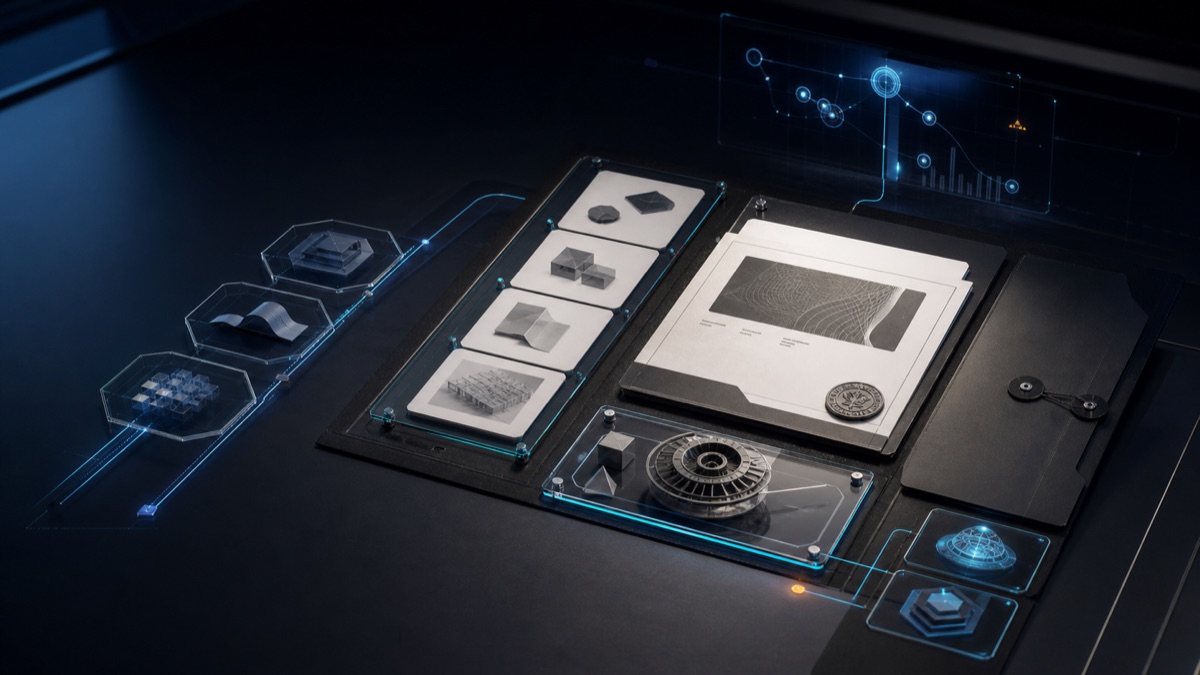
Editorial concept only. It is not a live LMS screenshot, accredited credentialing system, production assessment engine, or proof of completed student outcomes.
A learner should see the category, subcategory, level, course state, and next lesson without needing to interpret the whole 1,000-course catalog first.
Packet field: course pathEvery strong artifact should show how the learner handled source language, established science, speculative extension, risks, and missing evidence.
Packet field: rubric traceWhite Noise Academy certificates can be useful because they name the studied material and depth while staying explicit that they are not accredited qualifications.
Packet field: certificate scopeThe strongest next action is not always another course. It may be a member portfolio note, a lab-ready question, a Club contribution, or a Custom R&D scoping request.
Packet field: next routeThe page now treats the Academy as an artifact-generating product, not only a course directory.
Filter by category, subcategory, level, or search intent.
PortalCarry the record forwardUse the member surface as the natural home for saved progress.
ProvenanceReview image receiptSee the prompt, usage boundary, checksum, and placement notes.
Search the 1,000-course roadmap by topic and level. “Open course” leads to published material; “In development” marks a planned course.
A strong course should give you something to inspect, not just something to memorize. The Academy now links its core themes to an original visual atlas so learners can move from intuition to mechanism, evidence, and critique.

Replace a popular myth with the phenomenon that does the work.

Learn the system on its own terms before testing its claims.

A speculative target can orient practical work without becoming fact.

Every model clarifies some things by leaving other things outside.
Start with a scene, name what you think is happening, then use the linked essay and course catalog to test your explanation.
Browse courses →A few things learners ask before opening the catalog. Still curious? The full Q&A goes deeper.
Member access covers the Academy offering described on the membership page. The catalog contains 1,000 planned courses; only entries marked ready currently have published course pages.
No. Every category carries a Foundations level written for a cold start, so you can meet any topic where you are. See how the four levels work.
The planned format includes extended lessons, three checkpoint quizzes, a final test, and non-accredited completion. Review the available course page for its current content. Look inside a course.
Available courses are self-paced. Course selections and portal records are stored in your current browser and do not automatically transfer to another device or domain.
Each names the category and the depth you reached, and lives in your Member Portal — a White Noise Academy credential, not a substitute for accredited qualifications. More on certificates.
Use your notes to frame a research question, a creative project, or a Custom R&D inquiry. Further work requires a separate assessment of scope and feasibility.
Academy access is included with a Member plan. See what Membership includes.
The Member plan is $25/mo. Review the current Academy and library offering, published course availability, and membership terms before joining.