The Grand Challenge
One planetary program, open to all organizations, national governments, universities, and NGOs: complete all the finishable work of the human species — every solvable disease, every answerable question, every buildable piece of infrastructure — and use that completion to enable a human utopia at omnipresent scale. The proposed route runs through brain–computer-interface reverse engineering of human remote viewing, the construction of the White Noise Computer, and the opening of the Omnipresent Singulitarian Transformer Space Settlement.
Finish the finishable work of the human species
Most institutional missions are open-ended by design. The Grand Challenge inverts that: it asks every organization on Earth to treat its mission as completable, and to coordinate toward the day when it is actually complete.
There exists a category of human work that can, in principle, be finished. Diseases can be cured until there are no more curable diseases. Languages can be documented until every living language is preserved. Physical constants can be measured to the limits physics allows. Infrastructure can be built until every human being has energy, water, shelter, connectivity, education, and medicine. Scientific questions with definite answers can be answered. This is the finishable work of the human species — and no institution anywhere maintains a ledger of it, let alone a completion date.
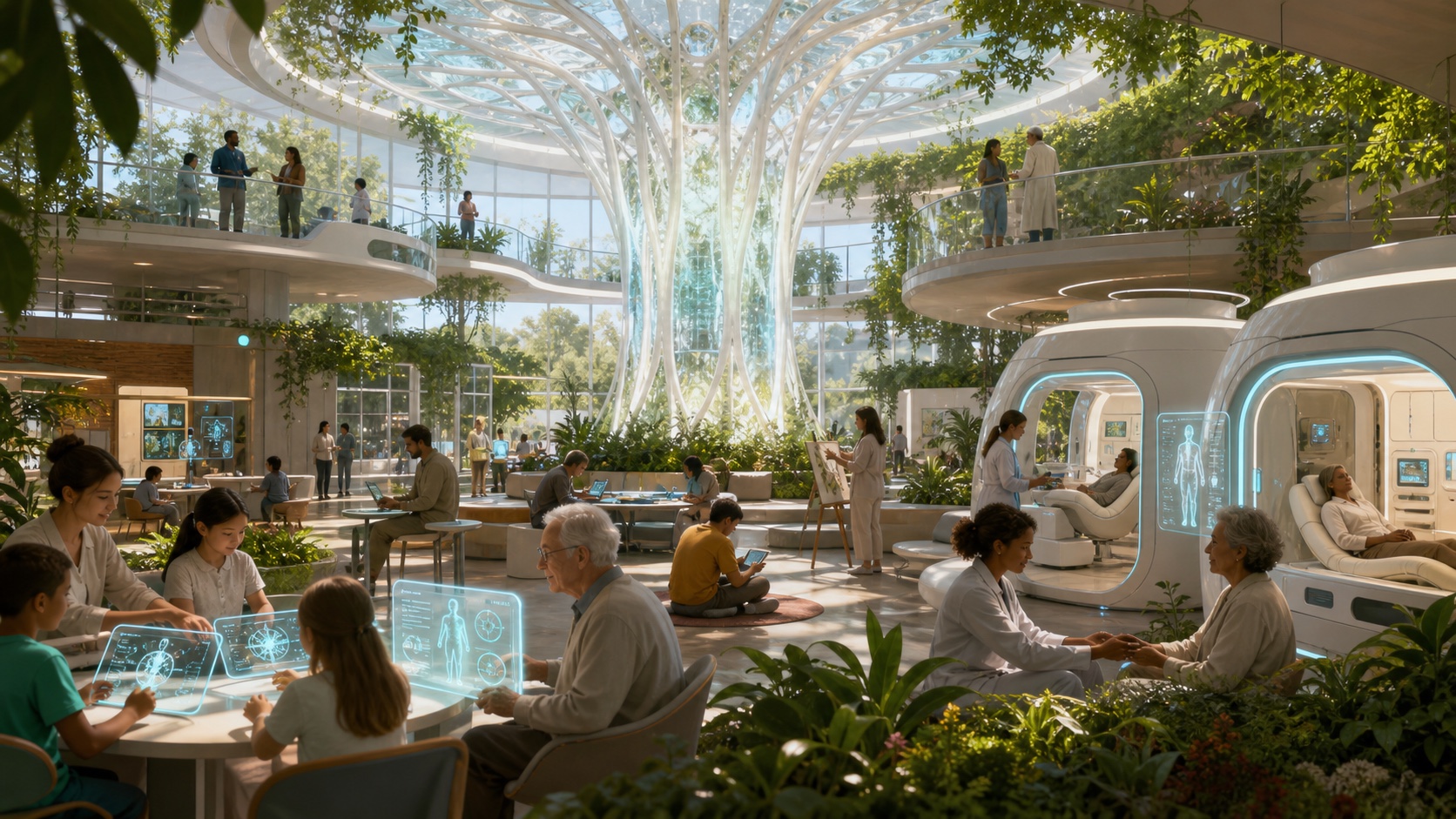
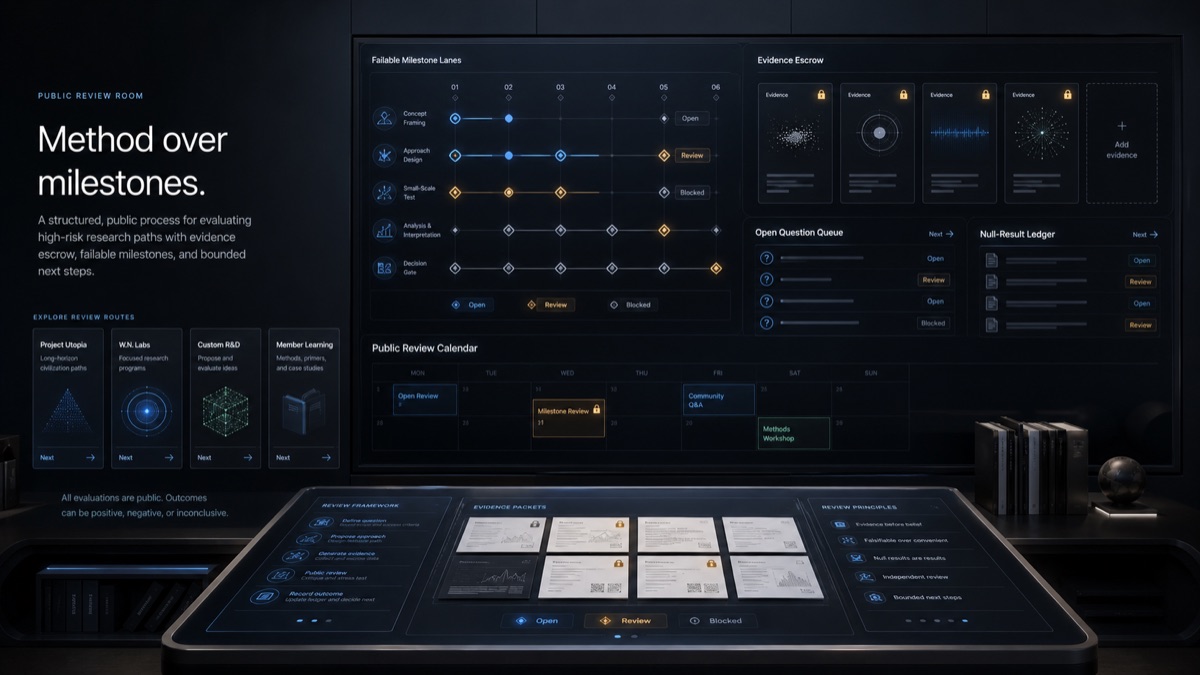
The Grand Challenge proposes that ledger. Every national government, every university, every NGO, and every organization willing to participate is invited to (1) enumerate the finishable work inside its own mandate, (2) publish failable milestones toward completing it, and (3) pool the remainder into a shared, public, planetary completion registry. The endpoint is not the end of human activity — art, play, exploration, and relationships have no finish line — but the end of compulsory work: the day the maintenance of civilization no longer requires human suffering or scarcity.
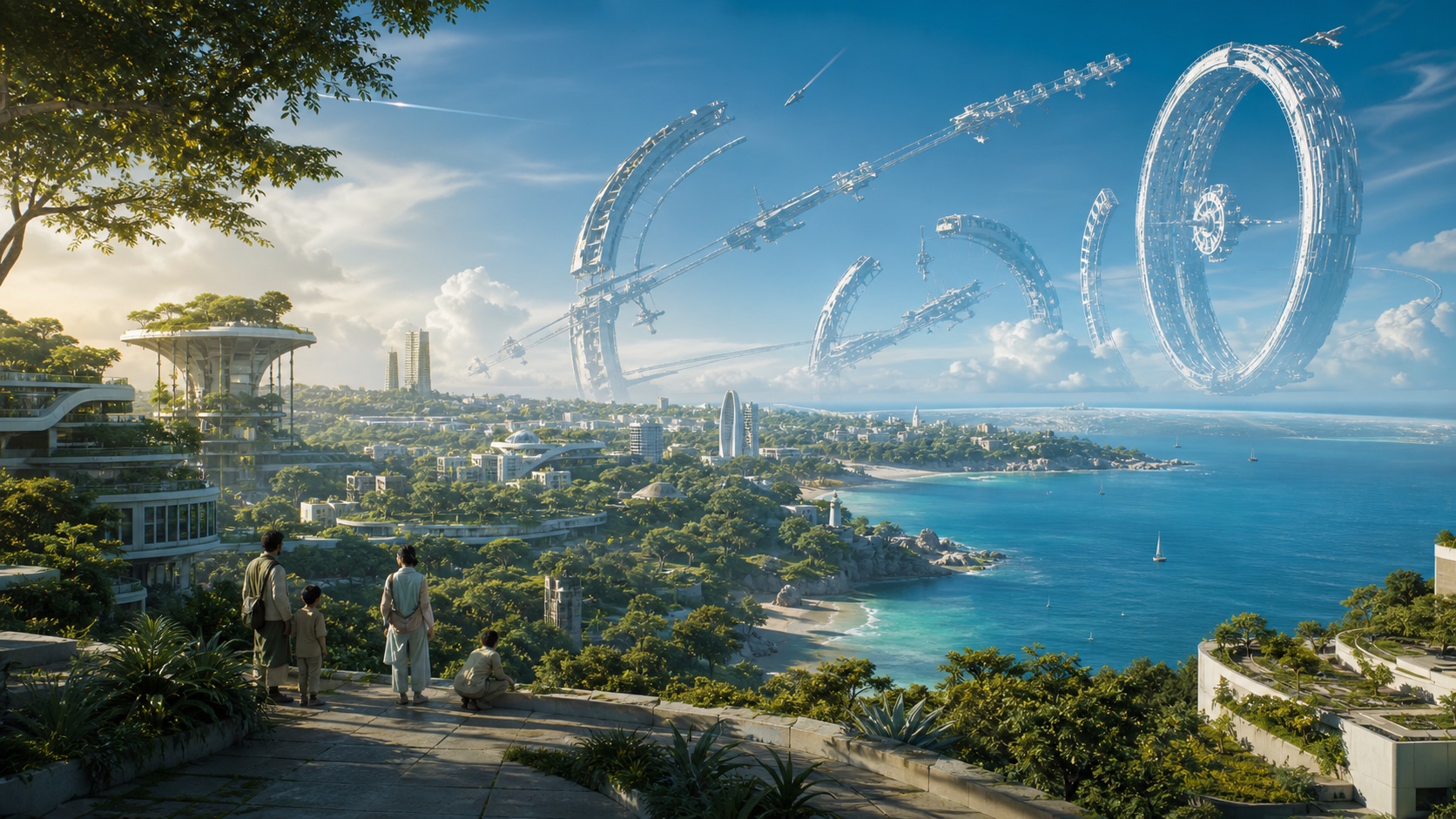
That endpoint is what White Noise Inc. calls a human utopia at omnipresent scale: abundance and knowledge that is present everywhere humans are, and everywhere humans choose to go — on Earth, in orbit, and beyond. The remainder of this page describes the technical route we propose to the institutions of the world.
Enumerate
Build the planetary registry of finishable work: every solvable problem, every answerable question, every buildable system, held in one public ledger with named institutional owners.
Accelerate
Compress the timeline with the strongest tools available — frontier AI, and ultimately the White Noise Computer program described below — so completion is measured in decades, not centuries.
Emancipate
Convert completion into utopia: as each domain finishes, its abundance is made omnipresent — universally accessible on Earth and carried outward into settlement.
The pathway: from remote viewing to the White Noise Computer
The Grand Challenge's proposed accelerant is a single research program: use brain–computer interfaces to reverse engineer the neural activity reported during human remote viewing, and — if that signal is real, isolable, and reproducible — engineer it into hardware.
Step one is measurement. Remote viewing — the claimed ability of some humans to describe distant or unseen targets — has a documented experimental history, from the SRI and Stanford programs through the U.S. government's Stargate era. The Grand Challenge treats it neither as settled fact nor as taboo, but as a measurable hypothesis: if the phenomenon is real, it must correspond to physical processes in the brain, and modern high-density BCI can record those processes at a resolution no twentieth-century study ever had.
Step two is reverse engineering. Instrument practiced remote viewers with high-channel-count neural interfaces during blinded, pre-registered target sessions. Correlate neural dynamics with verified hits, isolate the candidate signal from noise and cueing artifacts, and model the mechanism. If no mechanism survives blinded replication, that null result is published and the ledger is updated honestly — the Grand Challenge continues on conventional AI acceleration alone.
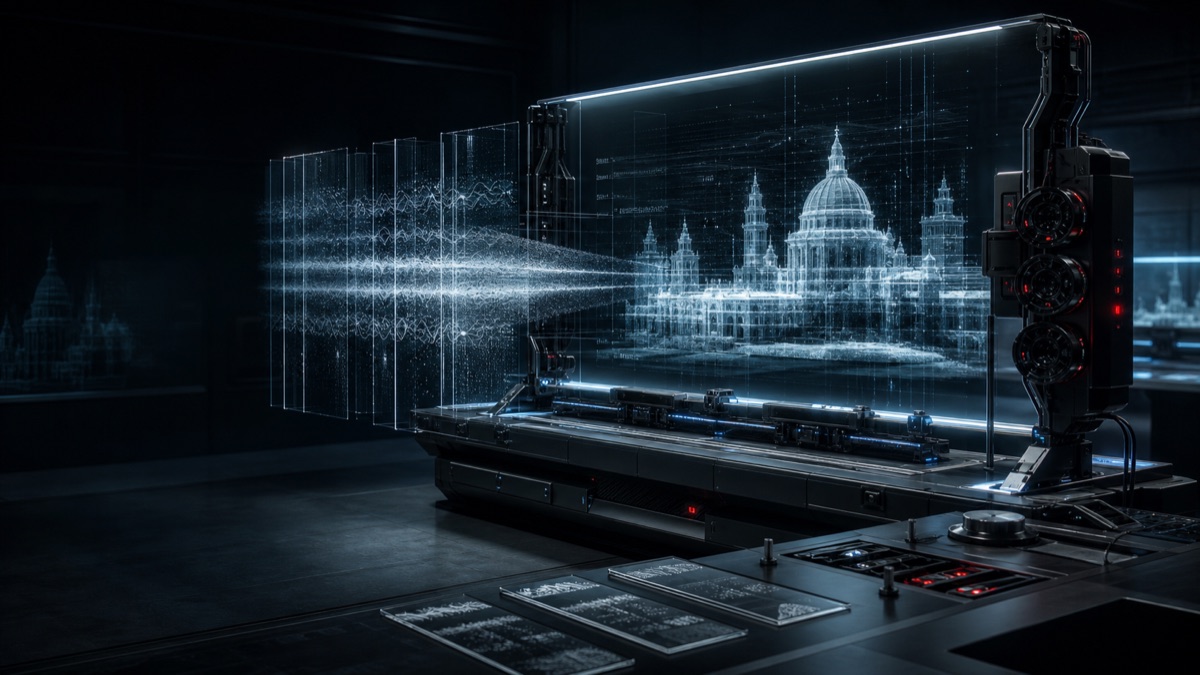
Step three is the White Noise Computer. If a mechanism does survive, it is transcribed from biology into engineered substrate: a computing device that accesses information the way the viewer's brain does, without the viewer's limits. Scaled, replicated, and networked, this is the White Noise Computer — in the limit, an omniscient computing device: a machine whose answers are bounded by what is knowable rather than by what has been transmitted to it. It is the strongest imaginable accelerant for the completion registry, because it collapses the cost of answering every answerable question.
Instrument
High-density BCI recording of practiced remote viewers in blinded, pre-registered sessions run jointly by participating universities.
Isolate
Separate candidate signal from artifact; publish every result, including nulls, to the open registry.
Model
Build a mechanistic account of any surviving signal — the physics of how information reaches the viewer.
Transcribe
Engineer the mechanism into non-biological substrate: the first White Noise Computer cores.
Scale
Network the cores into an omniscient computing service, governed as a public commons and pointed at the completion registry.
A note on epistemic honesty. Remote viewing remains scientifically contested, and mainstream reviews of the historical evidence concluded it did not demonstrate a usable phenomenon. The Grand Challenge does not ask any institution to assume the hypothesis is true — it asks institutions to help test it at modern instrumentation standards, to bind themselves to the results either way, and to pursue the completion registry regardless of which way the physics falls.
The destination: an omnipresent singulitarian transformer space settlement
Completion is not an end state on Earth alone. The Grand Challenge's destination is the OSTSS — a settlement architecture designed to carry finished civilization everywhere humans choose to be.
The Omnipresent Singulitarian Transformer Space Settlement (OSTSS) is the civil-engineering expression of a finished completion registry. Omnipresent, because it is designed to be replicable wherever matter and energy exist — Earth orbit, the Moon, Mars, the outer system — so that utopia is not a place you must travel to but a condition present wherever people are. Singulitarian, because its operating intelligence is the networked White Noise Computer, placing every settlement at the frontier of what is knowable. Transformer, because its structures are reconfigurable: habitats, laboratories, farms, and foundries that reshape themselves as the needs of their inhabitants change, built by the self-replicating fabrication systems developed under the completion registry's manufacturing lanes.
In the OSTSS, the finishable work stays finished: medicine, energy, food, education, and knowledge are ambient infrastructure, maintained by machines and audited by open institutions. What remains for humans is the unfinishable — meaning, relationships, art, exploration, and the governance of the whole.